An essay by A.V. Marraccini
Introduction to gen2GAN
I am here to tell you about two generative artists01 working in different modalities. I am here to tell you about Dmitri Cherniak’s algorithmic02, deterministic outputs and Helena Sarin’s GAN03 responses to them in collaboration. But first, and you will have to trust me in this digression, I am here to tell you about eighteenth century French philosopher Denis Diderot and a conversational mishap on a staircase. Diderot recounts this incident with rueful self-reflection in his Paradoxe sur le comédien. Diderot was at a dinner party with politician and wit, Jacques Neckar. Neckar, on his way out the door, made a remark to which Diderot had no immediate response, no comeback, no witty parry. Neckar walked down the stairs to the exit. Just as he was leaving, Diderot finally came up with a reply, but he was too late.
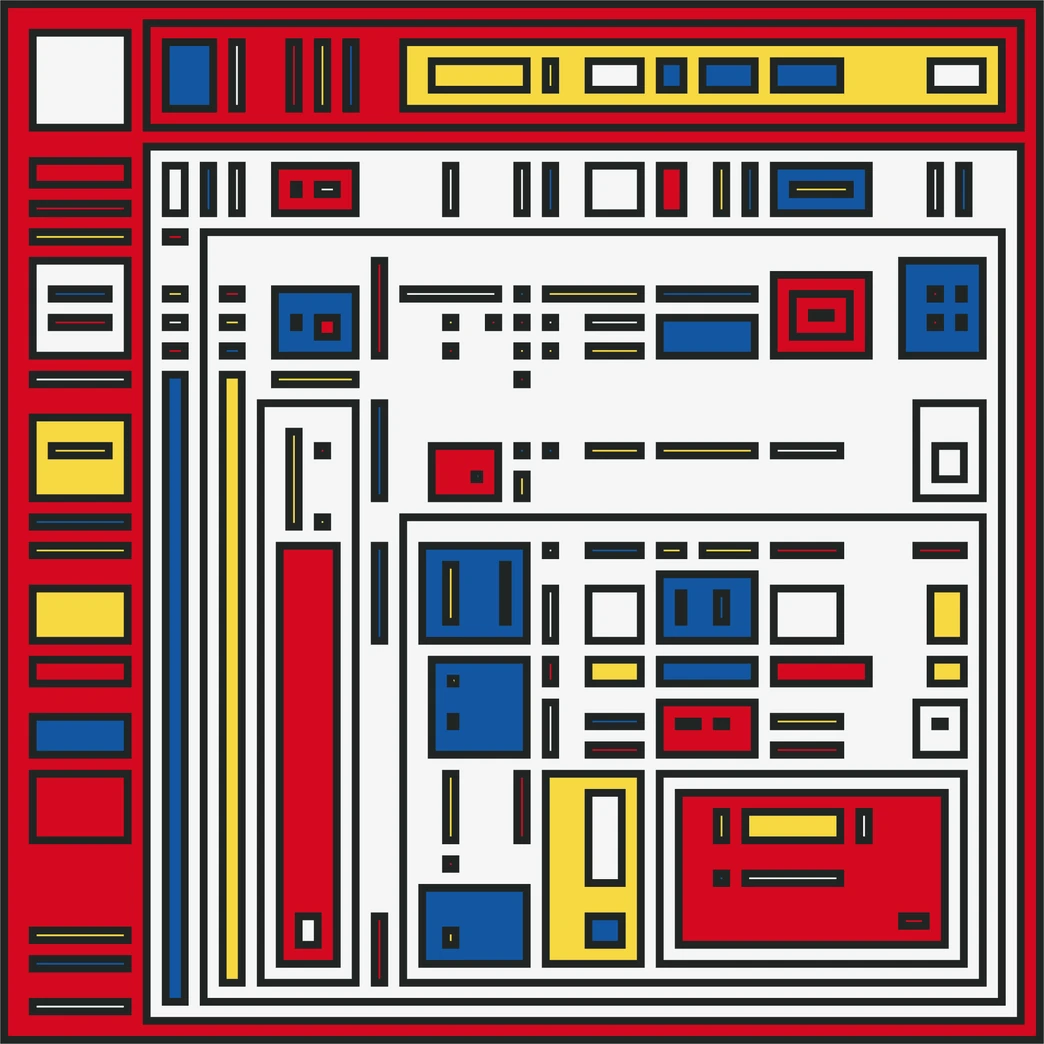
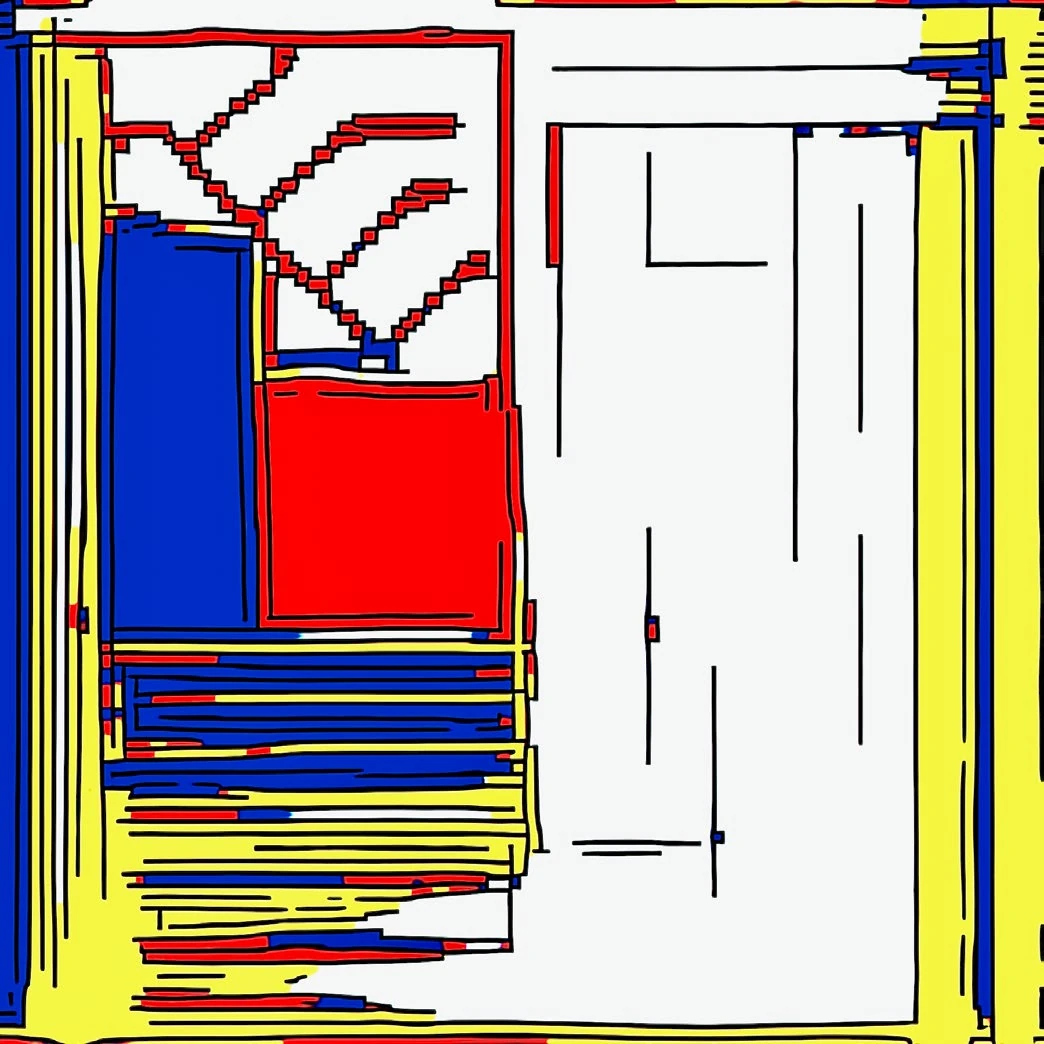
Like Diderot, we’ve all been in such a situation, when in retrospect we know the perfect response, but retrospect is all too late. Diderot, in a tribute to when this first happened to him, named these too-little-too-late moments l’esprit de l’escalier – literally the spirit or mind of the staircase, but more conversationally staircase wit. Now pivot to another staircase: Helena Sarin’s “escalier,” paired on pages 37-38 of this volume with Dmitri Cherniak’s output “779.” Cherniak’s output here is characteristic of his work; crisply elegant, evocative of Bauhaus influences and a Mondrian palette of deceptively simple primary colors. So too, is Helena Sarin’s piece, at once a gesture toward Suprematist forms of geometry and a kind of delicate, organic warping that subverts them. Cherniak’s initial dataset04 could have never anticipated Sarin’s response in this form; Sarin’s methodology using stages of culling GAN outputs that are not under absolute control could never have entirely made it. Yet nonetheless, in combination, the two works as outputs solve the problem of Diderot’s l’espirit de l’escalier: “escalier” is the witty answer “779” could have never imagined paused at the top of the landing.
For the gen2GAN project in general, Cherniak generated thousands of outputs, and Sarin used them as the inputs for her own GAN method, which in turn generated a similarly large number of outputs on its own. The two data sets, even the outputs not depicted in this book, are always already in conversation. In assembling the page spreads, curator Sofia Garcia put them in direct dialogue. Output 779 is one of about 1500-1800 total outputs from the algorithm Dmitri Cherniak named Auto Neoplasticism, in reference to De Stijl artists in the Netherlands. Mondrian in particular offers the clear rectangular antecedents for these outputs in general. “Escalier,” Helena Sarin’s GAN output, proceeds from a custom training set of only Auto Neoplasticism outputs. Throughout the images made for this book, Sarin uses the basic GAN process of CycleGAN05 and SNGAN_projection06, which don’t rely, unlike commercial alternatives, on an external image databank, and can be shaped in latent space to Sarin’s own preferences as they develop. Using a generator07 and discriminator08, a GAN algorithm produces a ‘new’ output based on its training images, and then decides whether that outcome is a ‘correct’ fit, which Sarin then runs and retrains until it satisfies her.
gen2GAN, then is also a conversation between two artists about what constitutes generative art. As a historical form rooted in the 1960’s and beyond, generative art generally relies on using process as a mode of both relinquishing, and finding new modes of, artistic control through automation and direction. Like the witty conversationalist, the generative artist must both anticipate and somehow create the unexpected from superficially logical, entirely expected means. The legacy of generative art includes computer algorithms, but also the geometric forms of Sol LeWitt and the grids of Agnes Martin. For this project, Dmitri Cherniak created five algorithms in total which supplied initial outputs that became the inputs for Helena Sarin’s GAN models: A Slight Lack Of Symmetry Can Cause So Much Pain I, Auto-Neoplasticism, Stained Glass, Good Russian Jew, and A Slight Lack Of Symmetry Can Cause So Much Pain II.
Consider a pairing that uses A Slight Lack Of Symmetry I: Cherniak’s output “973” with Sarin’s output “The Family Nest.” 973 looks like a pinball machine designed by Walter Gropius. It is clearly strictly rules-bound, but the rules for four balanced balls – really just circles in four of the work’s colorways – fall outside the tracks of the lines. It has a target-like anchor point at the bottom that draws the eye but that remains tantalisingly enclosed. The color percentages are used according to the frequency with which they appear in Ellsworth Kelly’s Spectrum Colors Arranged by Chance, 1951-1953. By contrast, Sarin’s “The Family Nest” seems to break any bounds or rules that it also implies. Two anthropomorphic figures could also be an architectural overview of a burrow. Colors are not strictly segregated and bleed into each other organically. Lines merge or break off mid curve in a kind of refusal that is also an open embrace. The second work was generated from a data set containing the first, but one could never anticipate it knowing only the first output. Cherniak and Sarin together violate – or perhaps solve – the paradox of l’esprit de l’escalier outright. They each already know the generative framework for the question, and the one then makes a response before starting to descend the stairs.
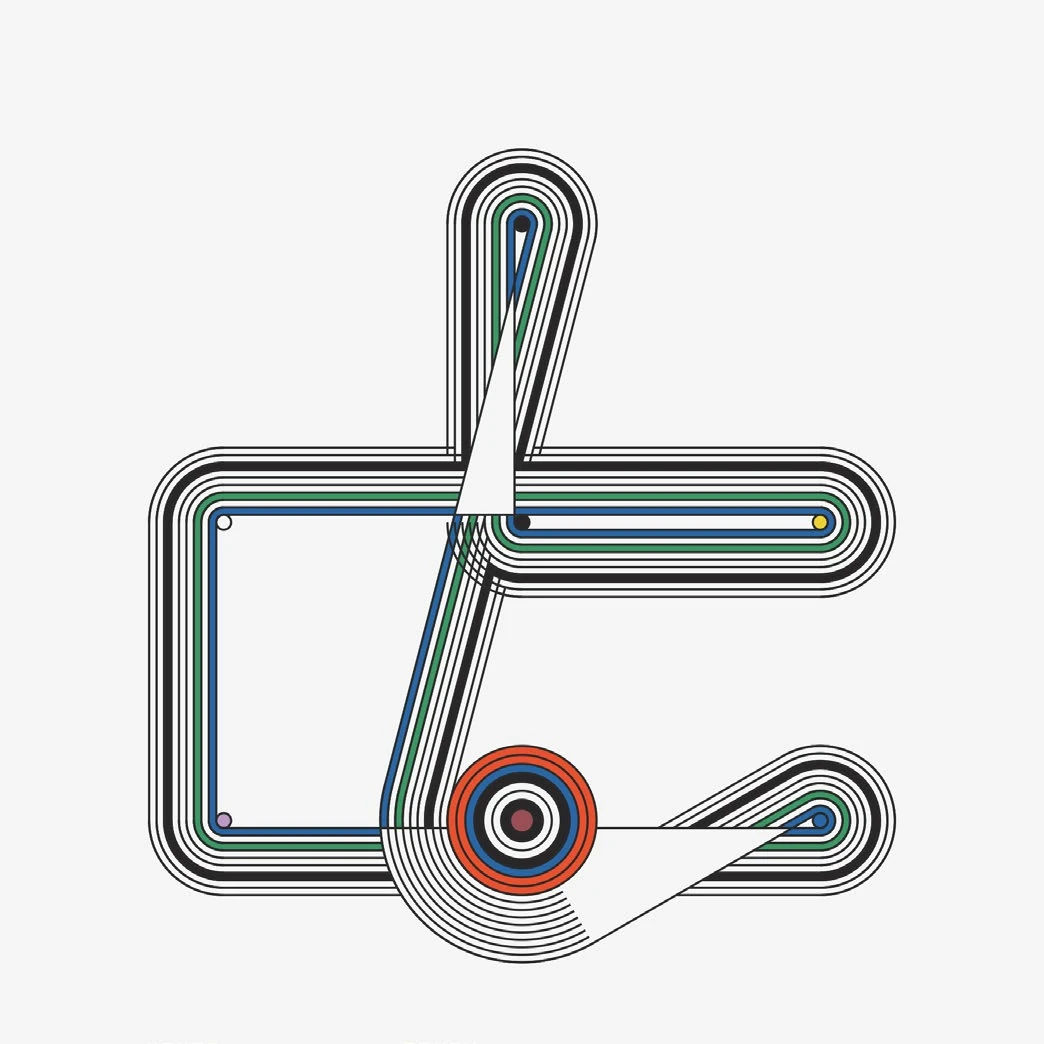
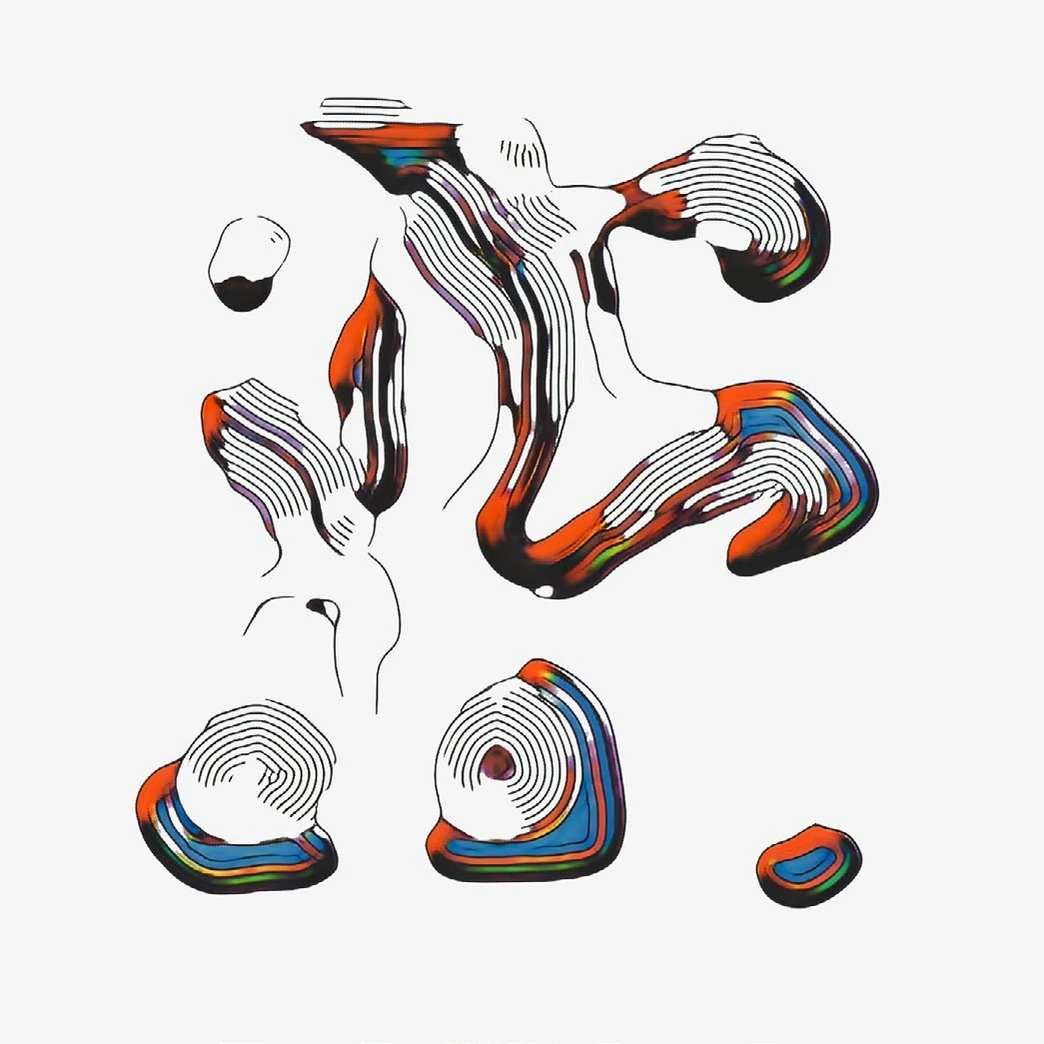
As Diderot would well understand, the quip, the comeback, and indeed, the response algorithm, draws strength from the personal as well as the systematic mode of thinking. A Slight Lack Of Symmetry Can Cause So Much Pain I and II in some ways resemble the artist’s iconic Ringers series, but the intentional lack of balance references his bout of pandemic scoliosis with a compositional wink. Good Russian Jew, a direct automation of a form by Suprematist Nikolai Suetin, gestures toward both creators’ Russian backgrounds and engagements with Russian artistic-intellectual traditions. Suetin was known mostly for his modern porcelain, which in turn evokes Sarin’s current practice of GAN-directed pottery-making and the language of physical shape and sculpture she uses to describe shaping her visual outputs. If for Cherniak, Good Russian Jew is a kind of koan, or midrashic re-iteration of lessons on color and geometry, for Sarin it seems like the visual equivalent of moving the feet through classical ballet’s five positions. In restriction, Sarin makes a new radically inventive vocabulary of expression, as when with her output entitled ‘All That Jazz,’ bodies wrought from Suetin’s formerly only straight lines seem to bend and groove across the page. She sends the Ballets Russes to a party with late 60’s LP cover design, and it works.
Dance is also an apt metaphor for the gen2GAN production. Garcia has used the word choreography in describing the process of lining up Sarin’s GAN outputs with Cherniak’s initial GEN ones for viewers. This captures the play of agency well; initially, the artists are both in total control of, and intentionally lack total of, their own outputs. Meaning, Cherniak programs logical algorithms whose visual outputs still have the ability to surprise him, and Sarin’s system of training GANs does the same. When they allow Garcia to further juxtapose their work, they add another intervening level of control. The two are like Phillip Glass and Twyla Tharp making the ballet In The Upper Room in 1986. The minimally rules bound, yet lush, score, which resembles Cherniak’s use of coded media, can stand alone. So too can the acknowledgment of, yet sharply re-staged form of Balanchine-esque modern movements of Tharp’s choreography, which resemble Sarin’s re-embodied GAN forms. With In The Upper Room, both Glass and Tharp, though, had to relinquish control to the ballet master of the company and the bodies of the performers to see the work completed. Here, Cherniak and Sarin engage in a similar process, relinquishing some forms of control to form an ultimately more engaging and complex whole, rooted both in their personal practices and in the broader history of generative art as form.
Machines are faster than us and more efficient in many ways. Generative art can make visual outputs extremely quickly, even ones that its coders cannot predict. Yet the framework of the staircase, the regret Diderot feels at his inability to form a witty response quickly enough, the question of the idea of a conversation; these are all profoundly human things. The algorithms that make the images of gen2GAN are themselves also profoundly human – written in languages purposefully invented by humans to make images with machines not as a substitute, but as a means. Both Dmitri Cherniak and Helena Sarin are asking us not what machines can do as art-makers, but what we can now ask of art itself now that we can descend and ascend the hypothetical staircase as many times as we want. Cherniak and Sarin work in concert. Look at these pages as testing the bounds of art as a kind of dialogic thought. They are philosophical provocations in the form of radically juxtaposed pas de deux.
This essay is an excerpt from gen2GAN, the book, published by DLC Arts in 2023.
Notes
- 01
Generative Art as it is known today is based on the premise of generating visuals built upon a system, or a set of predefined rules, expressed through a written computer program. ↩
- 02
Algorithm is a process or set of rules to be followed in calculations or other problem-solving operations, especially by a computer. ↩
- 03
GAN is a generative adversarial network (GAN) is a machine learning (ML) model where two neural networks compete with each other to become more accurate in their predictions. GANs usually run unsupervised and use a cooperative zero-sum game framework to learn. ↩
- 04
Dataset is a collection of related, discrete items of related data that may be accessed individually or in combination or managed as a whole entity. A data set is organized into some type of data structure. ↩
- 05
CycleGAN is a technique involving the automatic training of image-to-image translation models without paired examples. The models are trained in an unsupervised manner using a collection of images from the source and target domain that do not need to be related in any way. ↩
- 06
SNGAN_projection GANs with spectral normalization and projection discriminator. ↩
- 07
Generator in computer science, a generator is a routine that can be used to control the iteration behavior of a loop. ↩
- 08
Discriminator a circuit that can be adjusted to accept or reject signals of different characteristics in a dataset. ↩